

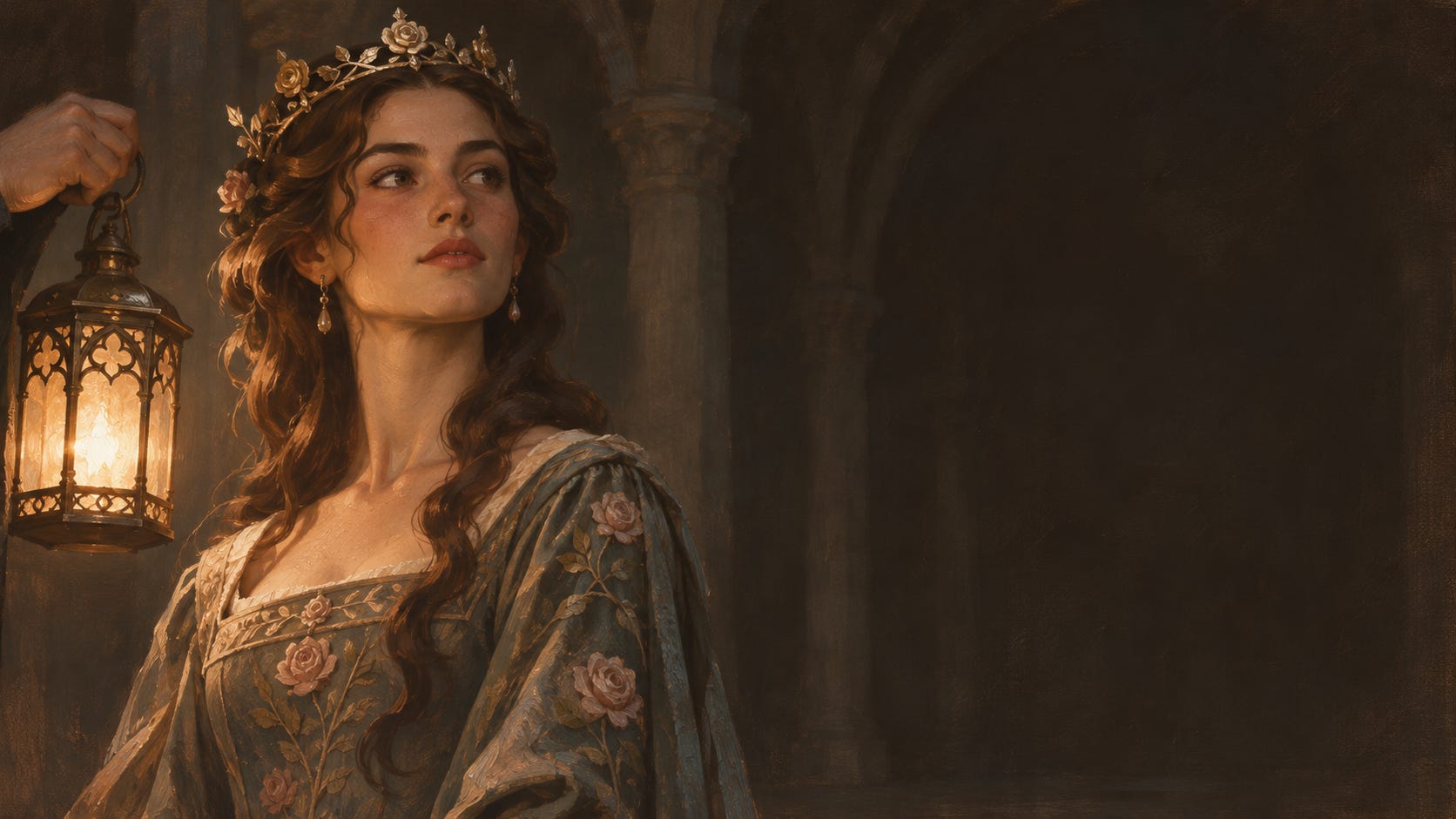
Margaery Tyrell arrives at her brother’s inquest wearing her crown, with the king close enough to hear her. When the High Sparrow calls her forward, she reminds him that she is the queen. He acknowledges the title and proceeds with his questions. She swears that the charges against Loras are false, apparently confident that her testimony, her family’s standing, and her marriage will carry the necessary weight. Then Olyvar describes a birthmark high on her brother’s thigh, and the protection she expected begins to disappear.
The Faith takes Loras into custody and arrests Margaery for lying under oath. As the guards lead her away, she calls out to King Tommen for help while he stands there, too weak a ruler to intervene. Until then, Margaery had been able to maneuver among powerful people by knowing who was in the room and how to reach them. She reads this room too, and she can see exactly who presides over it. What she counts on is the system beyond it, trusting that her husband’s title still tells her where the power lies. Tommen is the king, after all.
And therein lies her miscalculation. In this system, power has shifted to a dirty little man with a mission and a voice. The guards take their orders from the High Sparrow, and being King Tommen’s queen gives her no authority over them.
A leadership pattern describes a recurring way someone exercises authority or influence, organizes work, or responds to pressure. Bear in mind that a pattern’s usefulness depends on the conditions around it, which is why pattern literacy belongs in any leadership practice as a form of critical thinking. The patterns are there whether you see them or not, and your ability to read the conditions and run the appropriate pattern is the difference between a pattern running you and you running the show. For the full framework, visit the Leadership Patterns glossary.
Margaery runs Convener, at least until she starts voicing someone else’s script, and the pattern shows in how she chooses and works her alliances from season to season. As Renly’s wife, she keeps his and her brother’s secret with clear eyes, even offering to bring Loras into the marriage bed to secure an heir, because the arrangement keeps a crown on her head. When Renly dies, she tells Littlefinger, “I want to be the queen,” and the Tyrells turn her toward Joffrey. Betrothed to a king she has reason to doubt, she gathers the one person who knows him best. Alongside Olenna, she creates enough safety for Sansa to tell the truth about the man Margaery is expected to marry: Joffrey was a sadistic madman. Her read confirmed, she works him anyway, admiring his crossbow and steering his moods until poison ends his reign at their wedding feast.
Then comes Tommen, the king she can help craft, young, eager to please, and the most responsive throne she will ever stand beside. Westeros organizes Margaery’s route to recognized standing through marriage and dynastic service, then makes the effectiveness of her position contingent on the men around her. Renly, Joffrey, and Tommen each lent her standing, and each proved too short-lived, flawed, or weak to hold what they lent.
Her gathering reaches beyond the court as well. Early in Season Three, Margaery steps out of her carriage at an orphanage, speaks with children who have lost their families, and offers support for their care. Here we get our first glimpse of her potential as a Steward, using the attention that follows her to put the children’s needs before the court’s. The queen-to-be becomes someone the city can encounter through provision and concern, and her public charity gives people a reason to gather around her that reaches beyond the identity of her future husband. Still, she says what needs to be said to draw people close, and the city’s affection attaches to Margaery herself, which will matter once a man arrives with a cause.
The High Sparrow has a different way of moving people. I read his most active pattern as Standard-Bearer: he establishes direction, mobilizes followers, and turns a declared moral purpose into visible action against people previously protected by rank. His Narrator pattern supports that work by giving the action its meaning. Arresting a noble becomes evidence that the Faith can enforce its standard, and royal submission becomes evidence that the campaign is advancing.
For more on his Narrator read, revisit the Cersei installment…

Back to Margaery, who reads the room and recognizes the performance he expects. By the time she presents herself as a devoted penitent, she has endured imprisonment and seen what captivity is doing to Loras. Scripture, humility, and duty, the language of Standard-Bearer devotion, offer a way to become acceptable to the person controlling their release. For the first time, Margaery allows herself to be gathered on terms that steadily consume her ability to gather others.
With Tommen, whom she helps bring into the fold, her performance averts a public walk of atonement and places her beside him as the Crown and the Faith announce their alliance. Her charity once cast Margaery as the heroine, and now the Sparrow has recast her in a supporting role within his story of the Faith’s power to redeem the crown.
And the read remains intact, symbolized by the rose she slips to Olenna after understanding she was next on the Sparrow’s list of unrepentant sinners. Under Septa Unella’s watch, Margaery keeps the language of devotion and urges Olenna to leave, while the small drawing reveals the truth her grandmother needs before she goes, leaving Margaery without an ally whose standing could carry her warning.

In the Season Six finale, “The Winds of Winter,” Margaery continues to read the room and those absent from it. Cersei has failed to appear for her trial, and Tommen is missing too. Margaery understands that Cersei knows the consequences of staying away and has chosen to do so anyway. She urges the Sparrow to delay the proceedings and evacuate. When he dismisses her warning, she turns to Loras and tries to get him out. As the crowd finally moves toward the exit, too late, the Faith Militant block their path, and only the word of a Sparrow now frozen in place could move them.
What counterweight moves a Standard-Bearer who has stopped listening? A Standard-Bearer answers to the standard, and the Steward pattern, run by someone the city will follow, reminds that standard whom it is meant to serve. Margaery had the city’s affection, which attached to her person and could have grown into stewardship, and she handed it over when she aligned with the Faith. She has run out of time to reclaim her voice, and with it the chance to move from gathering with influence to leading with care.
The casting hands me a meta moment and a historical echo at once. Natalie Dormer played Margaery Tyrell in Game of Thrones and Anne Boleyn in The Tudors, two queens negotiating the conditions of consort power.
Anne supported religious reform, participated in networks that included Thomas Cranmer and Thomas Cromwell, and exercised patronage of her own; Historic Royal Palaces describes her preference for charitable uses of those resources and Cromwell’s direction of proceeds toward the royal coffers. Those activities did not give her control over the machinery that would be used against her. By 1536, Henry wanted her removed, her alliance with Cromwell had broken down, and Cromwell organized the accusations that led to what Historic Royal Palaces describes as a sham trial, and then her execution. Like Margaery’s charity, Anne’s patronage built a following that never commanded the guards.
Let’s put this Westeros tale in the workplace. Picture a high-potential director whose ideas and presence are in all the right places, thanks to being seen and championed by the division president. They may have earned that sponsorship through their own judgment and results, but their access to the leader supercharges their opportunities for growth and advancement. Then that president moves on, and the successor arrives with a turnaround mandate, a scorecard, and a mission to make their mark and stand apart from their predecessor. What happens to our superstar director?

Well, their ability remains, but they have work to do reading and managing to the new leader’s mandate, where closeness to the previous regime may read as a liability.
Sponsor dependence can develop through perfectly sensible decisions. A senior person opens a door, vouches for your work, and puts you in rooms where you can contribute. The dependency becomes material when your access, credibility, and permission to act all require the same person’s continued presence, and several sources of influence may turn out to have one lender.
The question I would ask is what your standing rests on when the person you are close to leaves the room. To begin answering it, try the Influence Map, an AI-prompted exercise in GWHQ Field Notes.