



We should all be aware of the new realities upon us, including the inverted labor market. This structure does not just affect people who are unemployed or early in their careers. It has reshaped how power moves through organizations, how decisions get made, and who absorbs risk when systems tighten. Even those who feel secure are operating inside these conditions, often without realizing how much the rules around them have changed, all while still feeling the effects.
This piece is not about predicting collapse or assigning blame. It’s about sharing knowledge. Because knowledge is one of the few tools workers, managers, and institutions still have to make intentional choices rather than reactive ones. When we understand how systems function, we’re better positioned to push for change—collectively, not just individually.
The labor market didn’t stall. It inverted.
That distinction matters. A stalled system suggests temporary friction—something that will resolve as the market flows. An inverted one signals a redistribution of power, risk, and movement. What we’re living through now is not a pause in opportunity, but a reconfiguration of who advances, who waits, and who absorbs the cost when movement stops.
For most of the modern working era, career progression was imagined as a ladder. You entered near the bottom, accumulated experience, and moved upward with some predictability and effort. It was never equally accessible, never fair, never universal—but it was legible. You could see where you were headed, even if the pace and access varied.
That ladder is busted, and what takes its place hasn’t fully revealed itself yet.
I have a working theory. But first, let’s talk about how we got here—and what it all means.
What an Inverted Labor Market Looks Like
An inverted labor market has three defining characteristics:
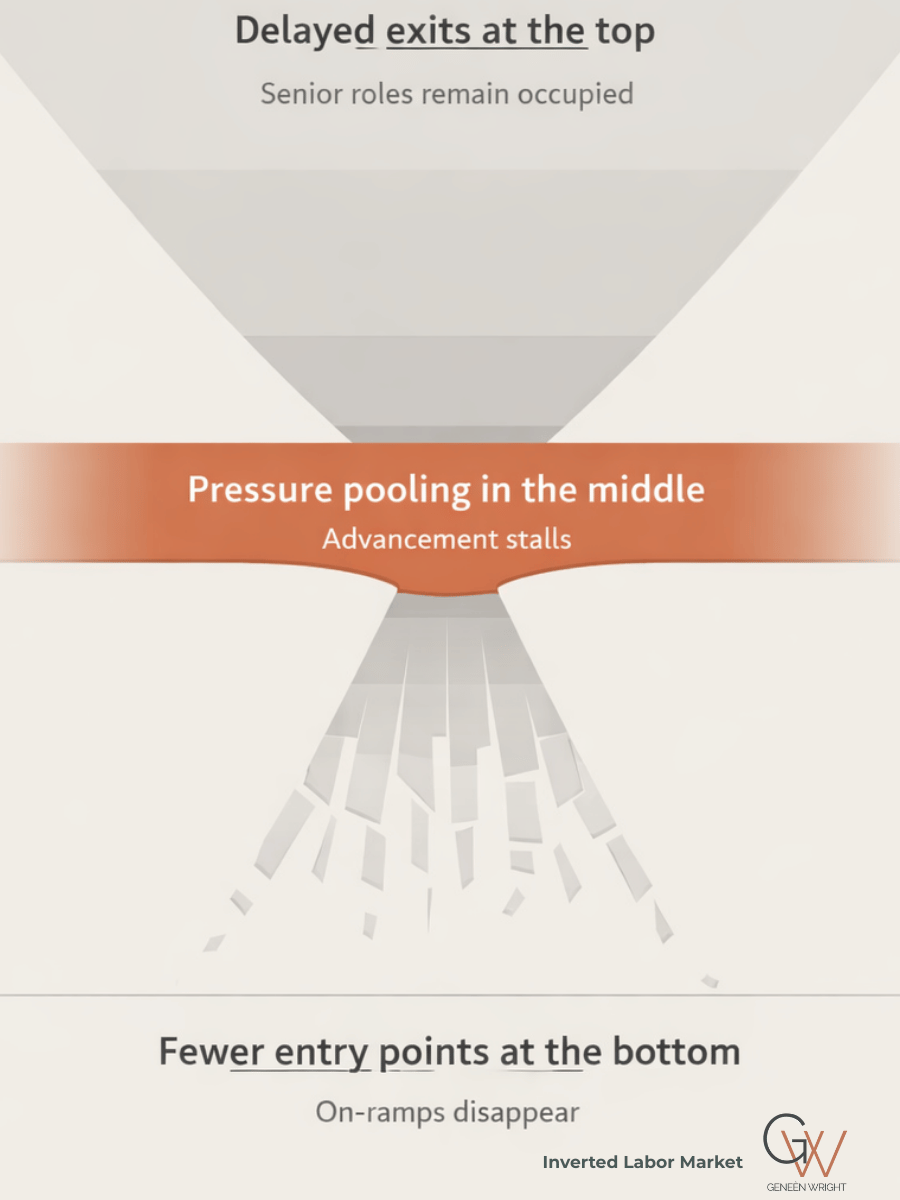
I’ve created a short checklist to help you assess where you sit in an inverted labor market, and how exposed you actually are.
You can download it below.
Entry-level roles have quietly disappeared or been reshaped beyond recognition—automated, outsourced, or reclassified as “early career” roles requiring years of prior experience. The marketing coordinator position that once trained recent graduates now asks for three years of experience with platforms that didn’t exist three years ago. The junior analyst role that introduced finance majors to modeling now expects proficiency in Python and prior internships at name-brand firms.
At the same time, senior roles have become sticky. Economic volatility, healthcare dependence, and the rising cost of leaving paid work have delayed retirement and reduced voluntary exits. What was once a predictable clearing at the top now stalls.
What’s left is a narrowing channel in the middle, where advancement slows and competition intensifies.
When movement stops, power doesn’t disappear. It concentrates.
How We Got Here
It’s tempting to romanticize a past where work “worked better.” That’s not the claim here. The claim is structural.
We’ve seen versions of this before. After the 1973 oil crisis, credential inflation accelerated as companies raised hiring standards without raising compensation. Following the 2008 financial crisis, firms learned they could extract more output from fewer people, permanently eliminating roles even as profits recovered.
Each downturn tightened access, and none fully reversed.
Technological change eliminated large categories of entry-level work faster than organizations rebuilt on-ramps. Meanwhile, the cost of economic insecurity rose, making exit from paid labor riskier at every life stage. The system recalibrated to protect continuity at the top and efficiency at the bottom, leaving the middle to absorb volatility.
The result isn’t just fewer jobs, it’s fewer pathways.
Power Shifts When Progression Stops
In a progressive system, power is distributed through movement. When people expect to advance, they tolerate friction because it feels temporary—they have a clearer expectations on what is next.
In an inverted system, advancement becomes scarce, and the reality of scarcity changes behavior beyond what the scarcity mindset only does.
Gatekeepers gain leverage. Hiring managers, budget owners, and intermediaries become arbiters not just of opportunity, but of timing. Decisions slow. Thresholds rise. Subjective criteria—fit, readiness, potential—carry more weight when objective movement stalls.
This is how experience inflation emerges. Entry-level roles require five to seven years of experience. Mid-level roles demand senior-level output without senior-level authority. Titles inflate while power remains fixed.
Consider the communications specialist with seven years of experience told she lacks “executive presence,” despite managing cross-functional teams and budgets. Or the software engineer with a decade of experience passed over because the org chart has nowhere to expand.
When advancement is scarce, compliance increases, not because ambition disappears, but because risk has nowhere else to go.
The Middle Squeeze
The middle of the labor market now carries the highest concentration of pressure.
These workers are experienced enough to be indispensable, but not positioned enough to be secure. They hold responsibility without insulation. They manage complexity without authority. They absorb workload, institutional memory, and change management simultaneously.
This isn’t accidental. In inverted systems, middle layers stabilize structures while absorbing volatility. Historically, they always have.
The project manager coordinating five teams but reporting through layers of authority.
The senior analyst building the models that drive strategy but excluded from the meetings where strategy is set.
Roles that keep systems functioning, until stability returns and the role quietly disappears.
The paradox is that these positions are framed as replaceable while being operationally essential. That contradiction produces burnout, disengagement, and quiet exit—not because people lack resilience, but because the system demands endurance without progression.

Early Careers Without On-Ramps
When entry-level roles shrink, so does learning.
Early career work has always functioned as a protected space for trial, error, and skill formation. When those roles are eliminated or professionalized beyond reach, careers become less navigable and more random.
The data science graduate receiving automated rejections from entry-level roles asking for experience with enterprise tools she’s never touched.
The English major with multiple low paying internships told she lacks “practical experience” for coordinator roles.
When young workers can’t enter systems, knowledge transfer breaks down. Organizations will eventually grasp for the next level in the workforce. The middle will not remain the middle (or engaged) forever.
Senior Roles That Won’t Clear
Delayed exits are often framed as a generational issue. That framing misses the point.
This isn’t about who wants to work longer. It’s about who can afford not to.
Healthcare access, retirement insecurity, and identity tied to work all reinforce delayed exits. Companies facing uncertainty choose continuity, over transition, even when it blocks advancement beneath.
[add an image that also gives insights to cost of transitioning executives with larger packages]
The system places risk on individuals, then penalizes them for staying.
When exits stall, progression becomes permission-based rather than earned.
Gatekeeping in an Inverted Market
In scarcity conditions, gatekeeping intensifies.
A single mid-level role draws hundreds of applicants. Hiring timelines stretch from weeks to months. Requirements that were once “preferred” quietly become mandatory. Additional interview rounds appear, not because earlier ones failed, but because abundance makes delay feel safe.
This is how systems reproduce themselves.
The people most likely to advance are those who already resemble decision-makers—culturally, professionally, ideologically. Diversity of thought erodes not through overt bias, but because stalled systems reward familiarity over experimentation.
Scarcity amplifies subjectivity.

Progression Without Movement
In response, organizations offer symbolic substitutes for advancement.
Lateral moves.
Stretch assignments.
Expanded scope without expanded authority.
The manager offered a “growth opportunity” leading an unpaid initiative outside her role.
The director assigned a “strategic” coordination role with no new budget or decision-making power.
The work gets done.
The structure remains intact.
History shows this pattern clearly. During the stagflation of the 1970s, companies created elaborate title hierarchies to signal progress while compensation and authority stagnated. Movement appeared to exist. Power did not shift.
Who This System Serves
Inverted labor markets don’t distribute pain evenly.
They reward those already positioned to withstand stagnation—those with financial buffers, institutional capital, and proximity to decision-making power. They slow change, narrow access, and concentrate influence among the familiar.
This isn’t a failure of individuals to adapt.
It’s a system allocating risk downward while preserving stability at the top.
What Comes Next
So what replaces the ladder?
Career corridors—not ladders, not paths, not journeys—where movement is narrow, monitored, and rarely self-directed. Attached is some strategic guidance in navigating an inverted market, because inversion isn’t a glitch, it’s a signal. And signals only matter if we’re willing to read them.

This is Part II of a three-part analysis of contemporary labor dynamics. Part I, 2025 Year-End Labor Notes, is available in the archive. Part III will examine the myth of the equitable labor market.

These sources inform the structural analysis, and gut checks, in this piece. The argument draws on historical pattern recognition rather than any single dataset or forecast.
Selected Sources & Further Reading
Labor Market Structure & Employment Trends
Bureau of Labor Statistics (BLS) — Employment Situation Summary; Unemployment Rate; Labor Force Participation
Federal Reserve Bank of St. Louis (FRED) — Labor market indicators and long-term employment trends
Credential Inflation & Entry-Level Job Decline
Harvard Business School, Dismissed by Degrees (Fuller & Raman)
Burning Glass Institute — Credential inflation and job requirements research
Post-Recession Labor Restructuring
McKinsey Global Institute — Automation, workforce transitions, and job polarization
Brookings Institution — Labor market recovery and job quality analysis
Delayed Retirement & Workforce Aging
Kaiser Family Foundation — Employer-sponsored health insurance and retirement timing
AARP Public Policy Institute — Older workers and delayed workforce exit
Gatekeeping, Hiring Practices & Organizational Behavior
Harvard Business Review — Hiring, promotion, and managerial decision-making under scarcity
The Conference Board — Workforce confidence, mobility, and advancement trends
Historical Context & Labor Patterns
Claudia Goldin — Labor market transitions, inequality, and workforce participation
David Graeber — Work, bureaucracy, and role inflation (conceptual framing)
Comparative & Global Labor Analogues
International Labour Organization (ILO) — Global employment and labor market restructuring
World Economic Forum — Future of Jobs reports (pre- and post-pandemic comparisons)