


Every corporate collapse, every labor crisis, every institutional failure begins the same way: with a story so compelling it becomes harder to question than to believe.
Business history is littered with convincing leaders whose strength, integrity, and even basic business acumen often look far more fragile in hindsight. They mastered narrative control, turning complexity into charisma, risk into vision, and accountability into atmosphere. These were not accidental storytellers. They were architects of belief systems that made scrutiny feel like betrayal.
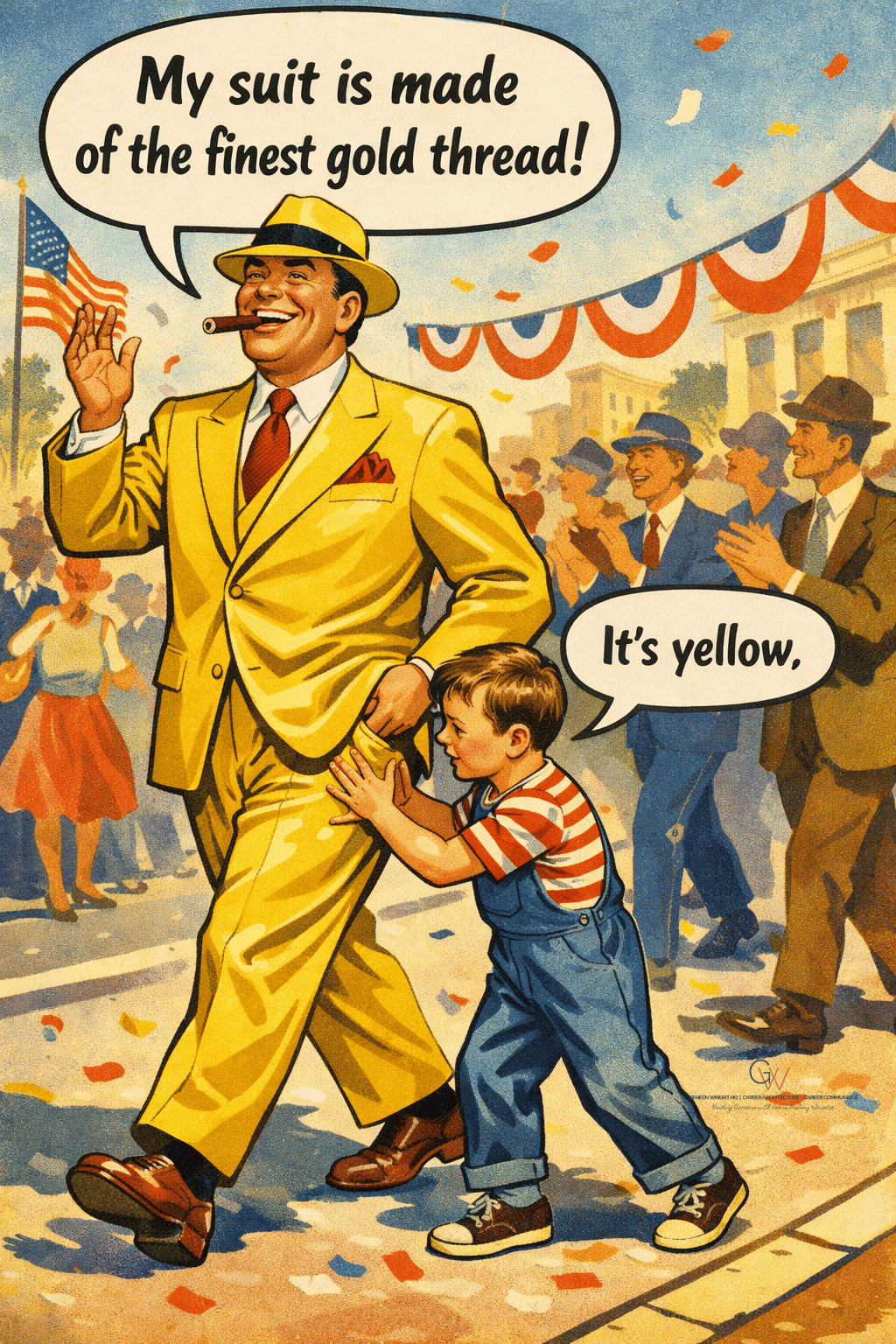
The unreliable narrator is a familiar device in literature, television, and film. We’re trained to notice the gaps—the evasions, the self-serving edits, the version of events that always leaves the teller intact. But in business, unreliable narrators don’t arrive with warning labels. They come with stock options, keynote speeches, glowing profiles, and board endorsements. They build cultures where doubt is disloyalty and evidence is optional.
Cut to the present: we are living through an era of narrative inflation. Leadership has always involved storytelling—vision, persuasion, meaning-making—but the distance between performance and reality has widened. Not because leaders suddenly became worse storytellers, but because modern organizations reward velocity over verification. Globalized operations make consequences diffuse. Financial abstraction insulates decision-makers from outcomes. And in periods of instability, institutions tend to overvalue confidence precisely when caution is most needed.
Workers need to know how to read the tells—not just for self-protection, but for structural literacy. Because unreliable narrators don’t merely damage individual companies. They hollow out industries, distort labor markets, and leave entire workforces holding the risk while leadership edits itself out of the ending, often with outrageously generous exits packages intact.
Welcome to another Career Communiqué pattern recognition exercise. Each case below illustrates a different mechanism for turning leadership into lore. We’re not here to gawk at failure—at least i did not write with that intent, but do with this information what you will. I am here to decode the systems that made belief easier than interrogation, so you know what not to build next.

Enron — Jeffrey Skilling & the Performance Illusion
Enron’s leadership wasn’t just fraudulent, it was theatrical. The company turned complexity into a moral virtue. If you didn’t understand the model or conform, the problem wasn’t the model—it was you. Volatility was framed as innovation. Accounting opacity was rebranded as intellectual sophistication.
Internally, Enron institutionalized fear through forced-ranking systems that pitted employees against one another. Skepticism became career-limiting. Questioning assumptions was indistinguishable from signaling disloyalty. This was both cultural rot baked into operational strategy. A workforce under constant evaluation is easier to control and silence.
The Playbook
Intellectual intimidation (“If you don’t get it, you’re not smart enough”)
Stock price treated as proof, even as it was propped up by speculative accounting and earnings that existed largely on paper.
Performance systems designed to suppress collective resistance
Why People Followed
Enron emerged from the late-20th-century convergence of Texas energy culture and Wall Street financialization. The deregulation era rewarded aggression, deal-making bravado, and winner-take-all logic. This was also the afterlife of the efficiency movement: Frederick Winslow Taylor’s scientific management, stripped of stopwatches and reborn as disruption. Human judgment was framed as inefficiency; complexity became proof of genius. People didn’t just follow Enron’s leaders—they internalized the belief that doubt itself was obsolete.
The Lore
Success was defined by optics, not outcomes. The story mattered more than the reality—right up until it didn’t.
Theranos — Elizabeth Holmes & Vision Over Verification
Holmes positioned belief itself as leadership. The product was scientific, but the scrutiny was proprietary. Data was always coming. Validation was always imminent. In the meantime, faith would have to suffice.
Theranos constructed an ecosystem where questioning the technology was framed as a failure of imagination. Scientific rigor was postponed in favor of momentum. And because the company controlled access—to data, to labs, to narrative—verification became structurally impossible.
The Playbook
The myth of the singular visionary (Edison comparisons, turtlenecks, keynote mythology)
Boards selected for prestige, not domain expertise
“Fake it till you make it” stretched into “never check anything”
Why People Followed
This wasn’t an anomaly—it was Silicon Valley logic operating as designed. Theranos inherited a lineage that prizes disruption over discipline and treats skepticism as a threat to velocity. This mirrors older labor systems more than we like to admit. Company towns of the late 19th century functioned the same way: when the storyteller owns the infrastructure—housing, currency, access—truth becomes subordinate to loyalty.
The Lore
Confidence and connections replaced evidence. Questions were reframed as a lack of vision.
General Electric — Jack Welch & the Cult of the Metric
Jack Welch was celebrated as a management savant, but the costs of his philosophy emerged only after the applause faded. His tenure accelerated financialization, normalized mass layoffs as discipline, and optimized GE for quarterly performance at the expense of institutional resilience.
Internal pushback existed—but it was systematically disincentivized. Rank-and-yank created a culture where survival depended on outperforming peers, not improving systems. Long-term investment became risky when short-term metrics governed reputation.
The Playbook
Quarterly performance framed as leadership virtue
Layoffs rebranded as accountability
Shareholder value elevated above organizational health
Why People Followed
Welch’s system echoed earlier efficiency movements, where measurement promised fairness while quietly narrowing what counted as value. As with Taylorism, the question wasn’t whether metrics worked, but who they worked for.
The Lore
Metrics were treated as truth, not decisions. The system was never questioned—only the people who failed within it.
The Pattern Persists
Unreliable narrators don’t thrive because people are foolish. They thrive because systems reward belief faster than verification. When leadership becomes lore, patience is framed as laziness, scrutiny is treated as rudeness, and alternative views are positioned as disloyal—while risk quietly migrates away from those telling the story.
Career literacy in this era isn’t about cynicism. It’s about pattern recognition.
The future of work will not be saved by better stories.
It will be stabilized by leaders, and workers, who know when to stop believing them.
Across industries, eras, and leadership styles, unreliable narration follows a familiar arc:
Complexity is reframed as genius
When systems become difficult to explain, opacity is sold as sophistication.Confidence substitutes for verification
Decisiveness is rewarded more than accuracy; speed outruns scrutiny.Metrics or vision are elevated above lived impact
Numbers or narratives become proxies for truth, even when they obscure harm.Dissent is moralized instead of debated
Critics are labeled resistant, emotional, disloyal, or “not strategic enough.”Risk is redistributed without acknowledgment
Workers absorb instability while leadership insulates itself through exits, compensation, or reputation management.History is edited into inevitability
Warning signs are minimized, timelines compressed, and outcomes reframed as unforeseeable.Failure is narrated as external
Markets shift. Conditions change. No one in charge appears to have been.
This is how leadership stops functioning as stewardship and starts operating as storytelling infrastructure.
And once a system reaches this point, collapse is rarely sudden.
It’s already been normalized.
Where This Leaves Us
The unreliable narrator isn’t just a leadership failure—it’s a literacy gap.
Managers are rarely taught how to notice when their own storytelling begins to crowd out reality.
Workers are rarely taught how to operate inside systems where narrative power outweighs structural truth.
That gap is where careers stall, trust erodes, and entire organizations drift without correction.
So instead of ending with critique alone, Career Communiqué does what it’s built to do: translate pattern into practice.
The attached two checklists are designed to be read from opposite sides of the same system:
One for managers, asking: Am I leading, or editing the story?
One for workers, asking: How do I navigate leadership when narrative and reality diverge?
Both are about architectural awareness. Because in moments when leadership becomes lore, the most strategic move isn’t belief or rebellion—it’s discernment.

Reading List
My reading list are not exhaustive or prescriptive. It’s offered as historical and cultural context —for readers who want to understand how leadership narratives take hold, and the outcomes for when they do.
The Power Broker — Robert A. Caro
Not a business book, but one of the clearest studies of how narrative, institutional control, and legitimacy compound over time. Caro shows how power sustains itself not through brilliance, but through systems that make questioning costly.
If you want to understand how leadership becomes lore—and why people comply long after evidence erodes—this is foundational.
Moral Mazes — Robert Jackall
A classic ethnographic study of corporate life that explains how otherwise rational people participate in unethical systems without ever seeing themselves as unethical.
This book answers Why People Followed better than almost anything else I have read to date. It’s anthropological, not outrage.
The Lords of Easy Money — Christopher Leonard
An accessible, deeply reported look at how financial narratives (stability, inevitability, expertise) shape institutional behavior and distribute risk downward.
Helps to better decode the Lehman, Welch-era financialization, and the broader theme of confidence outpacing accountability.
Work Won’t Love You Back — Sarah Jaffe
Explores how belief, devotion, and identity are leveraged inside modern work systems, often to workers’ detriment.
This is the labor-side counterweight to leadership lore. It helps readers see how emotional narratives substitute for structural care.
Relevant on so many levels, and hits hard (in a good way). Thank you!