The Standard-Bearer Leads, but Let’s Talk Some Caution
Leadership Sustainability and Architecture
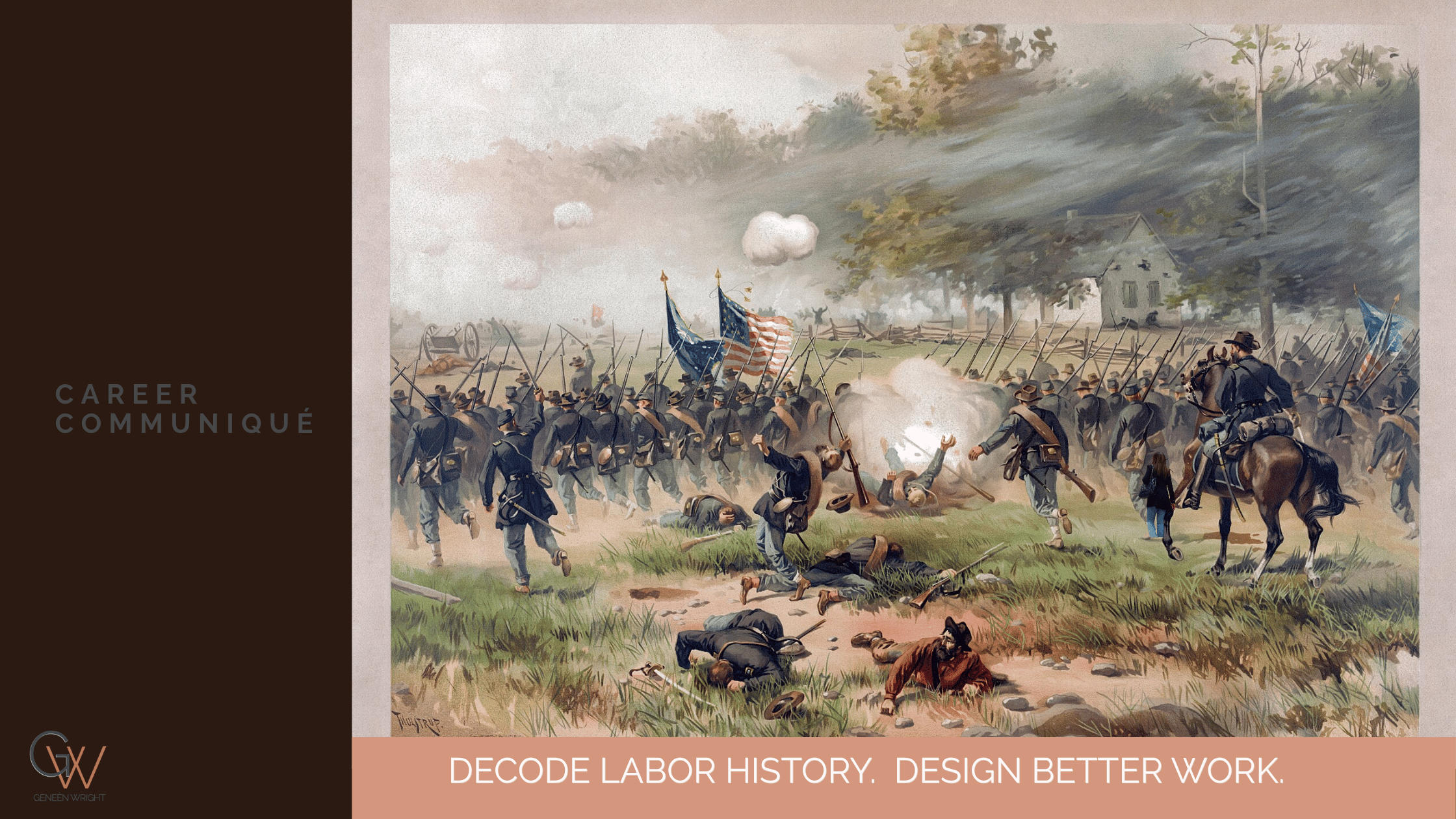
At Antietam, on the bloodiest single day in American military history, one of the most consequential figures on the field carried no weapon. He carried the flag. The role was simple in instruction and unforgiving in practice: the flag could not fall, because that waving standard told soldiers where to go, confirmed the regiment was still intact, and gave meaning to movement across ground they could barely see. When one bearer fell, another stepped forward — often dropping his weapon to do so.
That exchange is a leadership pattern. It shows up in boardrooms, social movements, political administrations, and the offices of companies you recognize by name. And it is one of the most frequently misread profiles in The Modern Manager typology. The assumption is ambition — that the flag is a vehicle for personal elevation. The pattern operates in the opposite direction. The standard drives the leader.
Which is exactly what makes the Standard-Bearer both indispensable and structurally fragile. Indispensable, because organizations need someone whose credibility is fused to the mission and can galvanize teams under it. Fragile, because the same fusion that creates authority removes the capacity to self-correct. The pattern holds the line — even when holding the line is no longer the right move.
“You’ve got to know when to hold ‘em, know when to fold ‘em, know when to walk away, and know when to run…” — The Gambler
What the Standard-Bearer believes about leadership shapes every decision the pattern makes:
Leadership is stewardship of something larger than the self
Retreat or compromise reads as betrayal, not strategy
Visibility is obligatory — the standard cannot function if no one can see it being carried
The personal cost of the standard is known and accepted in advance
This belief system gives the Standard-Bearer its force. Left unbalanced, it fuses leadership to stewardship so completely that dissent starts to look like disloyalty and visibility leaves no room for reflection.
Internal Architecture
One risk is what happens inside the leader when the belief system has no counterweight.
In October 1962, John F. Kennedy received confirmation that the Soviet Union had placed offensive nuclear missiles in Cuba. He had thirteen days to respond to a situation that could reasonably have ended in nuclear war. Pressure came from military advisors urging immediate airstrikes and political advisors calculating the cost of appearing weak. The standard Kennedy carried was the New Frontier: America as the leader of the free world, strong, decisive, and unafraid to act.
And yet, what Kennedy did in those thirteen days was not what the standard demanded. He refused the airstrike. He chose a naval quarantine, a slower, more controlled response that created space for negotiation without triggering an irreversible strike. He disagreed with his own Joint Chiefs. He wrote letters directly to Khrushchev. He treated the situation as a problem to be solved rather than a position to be defended. The Arbiter inside the Standard-Bearer was functioning — the capacity to adjudicate between what the standard required symbolically and what the situation required operationally.

Rewind to eighteen months earlier, at the Bay of Pigs, when a counterweight was not operating. Kennedy inherited a CIA-planned invasion of Cuba. And while he expressed private doubts, he approved it anyway, pulled air support at a critical moment in a way that satisfied no strategic logic, and then accepted public responsibility for a failure that was both predictable and preventable. Kennedy as Standard-Bearer was performing certainty without the Arbiter in the room.
The distance between those two moments is the distance between the Standard-Bearer functioning well and the Standard-Bearer functioning as a symbol of its own mythology. The internal architecture that the pattern requires — an Arbiter capable of adjudicating between conviction and consequence, and a Navigator capable of reading terrain rather than just holding the line — is not automatically present. When it is absent, principled leadership becomes the performance of principled leadership, and the decisions that follow start to serve the standard rather than the purpose the standard was built to advance.
The External Ecosystem
Internal architecture is only half the structure. The Standard-Bearer also requires a specific set of load-bearing relationships to do what the pattern is unable to do for itself.
On December 11, 1995, a fire destroyed the Malden Mills factory in Lawrence, Massachusetts. The 70-year-old owner, Aaron Feuerstein, had just watched the manufacturing facility his grandfather had built burn to the ground. The insurance payout would have been substantial, and he could have taken it, closed the plant, and moved production somewhere cheaper. Instead, he kept paying his three thousand employees their full salaries and benefits for three months while the plant was rebuilt.
The standard Feuerstein carried was loyalty as industrial obligation. Workers were not a cost line. They were the people the business existed to sustain. He became a national figure overnight. President Clinton invited him to the State of the Union address and the press named him the mensch of Malden Mills. What the press did not cover with equal attention was what happened next.
Malden Mills filed for bankruptcy in 2001 and again in 2003. The company that emerged from bankruptcy was no longer Feuerstein’s, so while the standard held, the structure had not.
Feuerstein’s story illustrates an external architecture gap that the Standard-Bearer pattern almost always carries. The pattern is exceptionally good at declaring what matters. It generates loyalty, clarity of mission, and remarkable short-term cohesion. What it does not generate, and structurally cannot generate from within itself, is the operational architecture required to sustain what the declaration commits the organization to.
The Standard-Bearer requires a specific set of external load-bearing sub-patterns to function at full capacity. They are:
The Architect— someone building operational infrastructure in support of the organization’s survival at scale.
The Agitator — someone empowered to challenge mythology before mythology becomes an organizational challenge.
The Reformer — someone keeping the standard tethered to consequence while translating principle into policy before the principle becomes a liability
Feuerstein’s circle lacked the Architect who could have looked at three months of payroll commitments and built the financial architecture to hold them. The standard was worth holding. The building around it was not built to code.
The Stop Mechanism
Internal architecture keeps the Standard-Bearer honest with themselves. External architecture keeps the organization functional around them. But neither addresses when the standard requires the Standard-Bearer to stop.
Cesar Chavez led one of the most consequential labor movements in American history. The United Farm Workers, founded in 1962 alongside Dolores Huerta, achieved what agricultural workers had been told was impossible: collective bargaining agreements, pesticide protections, and legal recognition for a workforce that the labor movement had historically excluded. The standard Chavez carried was the dignity of agricultural labor — the conviction that the people who fed the country deserved the same sustenance as all.
By the late 1970s and through the 1980s, the UFW was a movement in structural decline, and Chavez was the primary reason. He purged advisors who disagreed with him. He dismantled internal structures that might have operated with independence from his direct control. He prioritized the symbol of the movement over the operational capacity of the movement, and in doing so made the two things identical. The UFW became a body organized around Cesar Chavez rather than around the farmworker cause, and when those two things require different decisions, the pattern that has no stop mechanism will always choose the former.
The organizational consolidation had a human cost that extended beyond strategic decline. Documented allegations of sexual abuse and assault — some known within the movement’s inner circles for years — were not addressed, not escalated, and not stopped. A structure that had eliminated its Agitators and dismantled independent oversight had also eliminated the architecture that surfaces and stops harm. The pattern that cannot correct its strategic decisions cannot correct its behavioral ones either. The stop mechanism, once removed, does not operate selectively.
The Standard-Bearer’s structural flaw is the absence of an internal exit ramp. Stepping back does not read to the pattern as strategy or wisdom. It reads as abandonment — of the standard, of the people, of the meaning the carrier has spent years embodying. Ultimately, the pattern cannot distinguish between the health of the mission and the continuity of the person carrying it. Without an external sub-pattern authorized to make that distinction on the pattern’s behalf, the standard begins to serve the carrier rather than the cause.

Chavez’s later years stand as a Standard-Bearer pattern running at full capacity in the complete absence of the Agitator sub-pattern. The Agitators were gone — pushed out, marginalized, labeled as disloyal. What remained was a movement that could not metabolize internal dissent, could not build succession, and could not answer the question every Standard-Bearer eventually has to face: what does the standard require of me now, when what it requires is that I step aside?
Where This Pattern Lives Today
The Standard-Bearer is not a rare type. It is a common type in specific roles, and it is frequently rewarded until it is suddenly not.
Every one of these dynamics — the leader whose conviction outpaces their correction, the organization built around a symbol rather than a system, the movement that cannot survive its own carrier — lives in workplaces right now, perhaps your own. The question is what architecture exists around them.
What Good Looks Like
The Standard-Bearer functioning well is one of the most stabilizing forces in any organization or movement. The pattern at its best holds culture, direction, and meaning when everything else is shifting. It signals to every person inside the institution that there is something solid to stand behind.
What makes it possible is not strength of conviction alone. It is the deliberate construction of the architecture around the pattern, built specifically to do what the pattern cannot do for itself. The Architect, the Agitator, and the Reformer have to be given actual mandate, not ceremonial proximity.
Kennedy with a functioning Arbiter at the table in 1961 does not proceed to the Bay of Pigs. Feuerstein with an Architect in his leadership circle in 1995 rebuilds the plant and keeps the company. Chavez with an authorized Agitator in the room in 1979 does not become a cautionary tale on two fronts.
The difference is not whether the Standard-Bearer held it. The difference is whether anyone had the authority and the architecture to help them carry it.
The flag needs a body. The body needs a building around it.
The Work
This week’s pattern check is a single question in three parts, and it applies whether you lead a team, a function, a business, or a movement:
What standard are you carrying, and who in your current circle is authorized to architect it or tell you when the way you are carrying it is no longer serving what it was built to advance?
If you cannot name them, you may carry the standard, but you do not have the architecture that makes the whole thing sustainable. The Modern Manager™ System is where that architecture gets built.


